
Polk County Criminal Court Cases
Polk County divides criminal court cases by the level of the filed charge. The 258th and 411th Judicial District Courts hear felony matters. The District Clerk keeps those district criminal files. The County Court at Law hears Class A and Class B misdemeanors, and the County Clerk serves as its clerk. This split matters because a name search at one counter does not prove the other counter has no file.
Fine-only Class C charges and city ordinance cases stay with the issuing municipal court or justice court. Polk County has four justice precincts, and Livingston, Onalaska, and Corrigan keep municipal dockets. A failure-to-appear capias from one of those courts may never appear in the County Clerk's free index. Start with the charge class and the court named on the citation, bond paper, or notice. If those details are unclear, ask the arresting agency for its report number and the jail for the booking number, then use those facts to identify the court cause number.
Which Polk Criminal Clerk?
The two Polk County criminal clerks work in the same Judicial Center but keep different case groups. The District Clerk is in Suite 216 at 101 West Mill Street in Livingston and can be reached at 936-327-6814. The County Clerk criminal desk is in Suite 265 at the same address and uses 936-327-6805. Both offices publish weekday hours from 8:00 a.m. to 5:00 p.m.
Polk District Clerk
258th and 411th District Court felony files
101 W. Mill St., Suite 216
Livingston, TX 77351
936-327-6814
Polk County Clerk
County Court at Law misdemeanor files
101 W. Mill St., Suite 265
Livingston, TX 77351
936-327-6805
Do not rely on the county footer's historic courthouse address at 101 West Church Street for a criminal-record visit. The District Clerk moved to the Judicial Center in 2011. Calling the correct suite before travel also helps with older files, archive media, copy costs, and document availability.
Searching Polk County Case Records
Polk County offers more than one search route. The County Clerk page publishes credentials for a free misdemeanor index and provides a separate criminal-document request. Felony researchers should contact the District Clerk because the County Clerk login is not a district-felony search. The statewide re:SearchTX portal can supply case metadata from contributing courts, but its coverage and document access vary. Treat every remote result as a route to the custodian, not as proof that the online screen is complete.
- Identify whether the filed matter is a felony, Class A or B misdemeanor, or fine-only local case.
- Use the County Clerk's free index for its misdemeanor holdings, or contact the District Clerk for district felony files.
- Search re:SearchTX by party or cause number as a statewide cross-check, then confirm Polk County coverage.
- Read each count, docket event, and disposition rather than relying on the broad status label.
- Request the information, complaint, indictment, judgment, dismissal, or certified copy from the clerk that holds the original.
The available statewide search commonly works best with a complete name or cause number. A filing year and court filter help separate similar names. Date of birth can be restricted in a public view, so a clerk may need it as a matching detail even when the portal does not show it.
| Field Label | Type | Required | Notes |
|---|---|---|---|
| Party name | Text | Search dependent | Use full legal name and variants when known. |
| Case number | Text | No | The most precise route when the cause number is known. |
| Court | Select | No | Limit to a contributing Polk County court. |
| Case type | Select | No | Choose criminal where the interface offers a division filter. |
| Filing year | Date/year | No | Helps distinguish repeated names and older matters. |
The official re:SearchTX screen shows why search fields and access depend on participating courts.
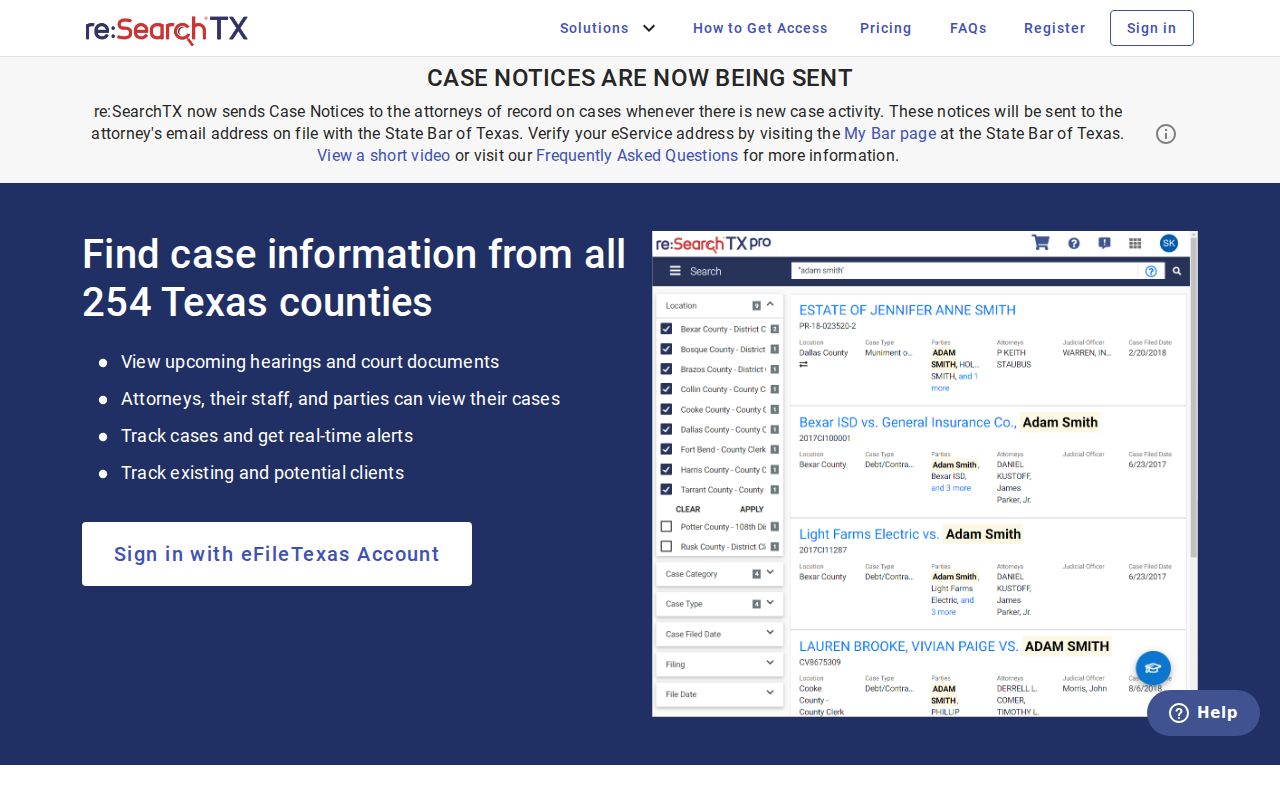
The portal can narrow the hunt, while the Polk County clerk remains the source for a complete or certified court record.
Polk Clerk's Free Criminal Index
The County Clerk publishes the username ccpublic and password public for no-charge index review. That access is useful for finding a County Court at Law misdemeanor cause number and basic case trail. It does not grant custody of district felony files, guarantee that every document image is online, or turn an index entry into a certified record.
For a document request, select the specific product rather than asking for a vague criminal history. The County Clerk form lists Information, Complaint, “Judgement or Dismissal,” Background Search Form, and Other. Its portal uses that spelling, though ordinary legal prose uses “judgment.” Regular copies cost $1 per page. Certification adds $5 plus $1 per page, and a background search form costs $5. Payment must be received before completion. Card payments carry a 2.40% fee or a $2 minimum fee, and the office states that a request can take up to ten days.
District Clerk copy and archive fees were not posted on the landing page reviewed. Ask Suite 216 for a quote before ordering a long felony file. A request for only the indictment, signed judgment, and sentence may be faster and less costly than a request for every docket document.
Inside a Polk County Case File
A Polk County criminal case file centers on one cause number. It can show the filed charge, the court's event trail, and the final result. That focus differs from a booking file, which records jail intake, and from a DPS rap sheet, which connects reported arrest cycles and outcomes across Texas. For most case research, the charging paper and signed judgment answer more than the broad portal status.
| Case number and court | Identifies the cause, filing date, case type, assigned court, and current status. |
|---|---|
| Charging document | A complaint, information, or indictment states the filed accusation, statute, and charge class or degree. |
| Docket entries | Chronological entries can record bond, arraignment, settings, motions, pleas, orders, and warrants. |
| Hearing dates | Show the date, time, court, and type of setting when the public view exposes them. |
| Disposition and judgment | Separates conviction, dismissal, acquittal, deferred adjudication, and other count-specific results. |
| Sentence and conditions | Records confinement, community supervision, fine, costs, restitution, or other terms imposed by the court. |
Public views may limit dates of birth, protected victim details, Social Security numbers, and financial identifiers. Document availability also varies by clerk and permissions. An index hit does not promise a free PDF, and a blank document link does not mean the signed paper never existed.
Reading Polk Criminal Dispositions
“Disposed” means the Polk County criminal court case is closed or resolved at the portal level. It does not identify the outcome. Open the count and inspect the disposition. A conviction should match a signed judgment. A dismissal ends that charge without conviction, but it does not by itself erase the arrest or booking trail. An acquittal is a not-guilty result after adjudication. Deferred adjudication places a person on community supervision without an immediate finding of guilt, and the public record may remain after a successful discharge.
- No bill
- The grand jury declined to return the proposed indictment.
- Information
- A prosecutor-filed charging instrument commonly used in misdemeanor cases.
- Capias
- A court writ directing arrest after a stated procedural trigger.
- Disposition
- The recorded outcome of a charge or case.
Read every count separately. One count can be dismissed while another ends in a plea or trial judgment. The initial arrest label may also differ from the filed charge after prosecutor review. For the arrest-side trail, the separate Polk County arrest lookup explains how agency and jail records fit beside the court file.
How a Criminal Case Moves
A Polk County prosecution can start after an arrest or summons, but the prosecutor decides what charge to file. An information begins many misdemeanor cases. A grand-jury indictment commonly starts the formal felony prosecution. The accused then receives arraignment, discovery and pretrial settings before a negotiated plea or trial. The court records the result and, if there is a conviction, enters the sentence. An appeal or later supervision action can add more entries.
Case flow: Charges Filed › Arraignment › Pretrial › Plea or Trial › Disposition › Sentencing
Texas law generally requires an arrested person to be brought before a magistrate without needless delay and no later than 48 hours after arrest. That limit concerns warnings, probable cause, and initial bond functions. It does not promise that Polk County prosecutors will file the final charge, or that a clerk will post a complete case, within the same period.
When re:SearchTX Misses Polk Cases
A no-result search on re:SearchTX is not a finding that no Polk County criminal court case exists. A court may not contribute the same date span or documents, a filing may be too new, a name may vary, or the case may belong to a municipal or justice court outside the county index. Search again with a cause number and name variants, then move to the actual custodian.
Call the County Clerk for a County Court at Law misdemeanor and the District Clerk for a felony. Ask a municipal court or the proper JP about Class C charges and failure-to-appear matters. For an older file, ask whether the record is archived or available only by counter or mail request. The Polk County District Attorney's discovery portal is not a public case search. It serves the defense discovery process, while the clerks preserve public court filings.
Save the court, cause number, filing date, and defendant identifiers from every reliable hit. Those details allow a clerk to distinguish close name matches and quote the right copy or certification cost.
Finding Polk Class C Cases
Class C misdemeanors and city ordinance charges do not belong in the County Court at Law merely because the event happened in Polk County. The issuing municipal court or justice court keeps that file. Livingston, Onalaska, and Corrigan each handle local matters, while Polk County's four justice precincts keep their own fine-only dockets. The citation or failure-to-appear notice should name the court.
If the County Clerk index returns nothing, call the issuing court with the name, citation or case number, date of birth when requested, and violation date. Ask for the current status before using a payment link. Paying a citation can dispose of it as a conviction, and a phone call alone may not count as a required appearance. A local capias can therefore remain outside the county misdemeanor portal until the issuing court updates its own record.
Case Record Access & Restrictions
Texas court records use the judiciary's access framework rather than treating every judicial file as an ordinary Texas Public Information Act request. The proper first channel is the clerk that holds the case. Executive-branch records, such as a police narrative, follow a different request path. Confidential criminal-history repository data can also remain restricted even when a related judgment is public.
Juvenile cases, sealed or nondisclosed material, protected victim facts, and personal identifiers can be withheld or redacted. A dismissal does not automatically clear the related arrest. Someone reviewing their own Polk County file after qualifying relief should obtain the signed order, allow processing time, and ask the originating clerk or agency about any item that remains.